
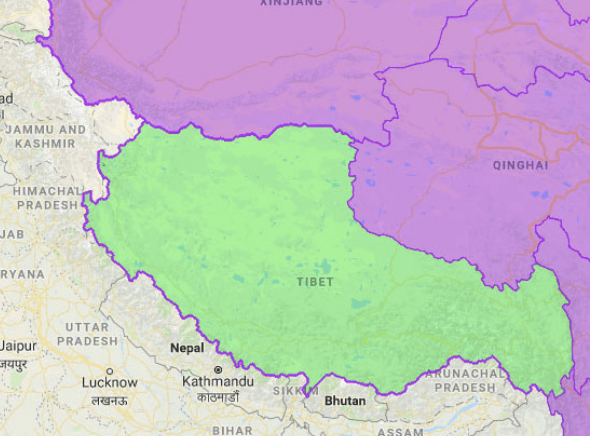
After “HIMALAYAS : INDIA AND CHINA” understanding Tibet is at core. Tibet is at the Arunachal Pradesh end in the East and Aksai Chin in West, could the British be missing?
Tibet land mass is not contiguous to China, India or Xinjiang. Himalayas with India and Kunlun and Qilian Mountain ranges in north and east separate it from China. While the challenge to India is just the Himalayas, to China it is the steep climb to Tibetan plateau from mainland China, crossing complete plateau to South and west to reach Himalayas. Tibet thus was a very closed independent country for better part of its existence.
We need to understand Tibet before we step into 20th century. Tibet exists from last 1400 years. It was ruled by various powers for 1000 years. Tibet enjoyed 400 years of independence from 14th century till it was defeated by Qing dynasty in 1720 AD. The Qing ruled for nearly 192 years till 1912 AD. Tibet has history of being fiercely independent but has been overwhelmed by Mongol and Chinese powers.
British appeared on scene in 1865. As always, British were at the core of the mess. Sikh empire had annexed Ladakh in 1834 and the land north of Ravi River was given to Dogras. In 1841, the Dogra-Tibetan war resulted in defeat of Sikh (Dogra) Army and in September 1842 the Chinese and the Sikhs signed a treaty which stipulated no transgressions or interference in the other country’s frontiers. After British defeated Sikhs in 1846, the sovereignty of Ladakh passed over to Britain. The boundaries between India and China were left un-demarcated. Dogra Army had maintained a fort in Shahidulla, Xinjiang which was reclaimed by China in 1890. Tibet thus was connected with India far back than is commonly understood.
The British, in their quest to expand, reached Lahsa in 1904 signed ‘Anglo-Tibetan Treaty of Lahsa’. It was for trade and Tibet was to pay a large indemnity to the British and until that was paid the Chumbi Valley (heard this name recently?) was ceded to Britain. The other points of treaty were that Tibet was not to be cede, sell, lease, mortgage or otherwise given for occupation their land to any foreign power, no power will be permitted to intervene in their internal affairs etc. and more such conditions that gave absolute control over Tibet to Britain. The British could not do without creating some mess, they accepted that Tibet remained under the sovereignty of the Qing Dynasty!
For 192 years Tibet was, against their wishes, ruled by Qing Dynasty till 1912, when the Provisional Government of Republic of China (PGRC) removed Qing Dynasty and as per treaty took over complete territories held by Qing Dynasty. Tibet, thus passed over to PGRC. Tibet wanted complete independence from China and around 1905 had a pact with Mongolia where both countries declared themselves independent from China. Tibet never wanted to be under China.
The Qing Imperial Resident in Lahsa repudiated the treaty while Britain announced that it accepted Chinese claims of authority over Tibet. In 1912, the Tibet-Mangolia pact and 1904 Anglo-Tibetan treaty were rejected by Qing Dynasty. Tibet was given complete autonomy as an independent state but no country in the world recognised it. Tibet tried to find their status and sent emissaries in 1931 and 1946 to Chinese National Assembly but were not entertained. In 1950 Communist Party and People Republic Army walked into Tibet.
In 1950 the Seventeen Point Agreement was signed by representative of Tibet with the Chinese reaffirming China’s sovereignty over Tibet the following year. Tibet has throughout maintained that the signatures were forged, no representative was sent and that the agreement was false. China flexed muscles and thus came to an end the Tibetan saga. The 11the country was usurped by China.
This in a nutshell was brief history of Tibet. 1600 years of existence snuffed by China. Tibet borders with the current Arunachal Pradesh, Bhutan and Sikkim in the East, Uttarakhand, Himachal Pradesh and Union Territory of Ladakh in Central and Western portions of India.
We are still way away from understanding the current border mess. We need to understand the developments between the period of 1840 AD to 1912 AD. These are historically very crucial years where multiple powers were involved. Britain controlled India, Qing Dynasty controlled East Turkistan and Tibet, Dogras controlled Jammu and Kashmir and the Sikhs controlled Dogras. Add to this the British Residents in Central Asia.
This in short will be called ‘72 Years of Mess – 1840-1912’. These years had a direct impact on India-China relations the birth year of which was 1947, with India getting its independence. Readers will be crystal clear on developments toll 1912.
My next article covers the ‘72 Years of Mess – 1840-1912’.
Col Sanjay Pande © Copyright
2 thoughts on “Article No. 4 : TIBET AT CENTRE : INDIA-CHINA SANDWICH”
Leave a Reply
Recent Posts
Mr Macha was born about two weeks ago. He is the first case where he grew each day by one year! He is 19 years old today. Mr Macha is all fun, frolic, health conscious and really cares about...
2012-Present : Advisor-Consultant for MNCs (Multi National Companies) Details covered separately on the website. 2012 - Present Kshemin Technologies Pvt. Ltd. Founded an independent...
Sanjay, very deeply analyzed. As a matter of fact, a majority of Indians do not know a thing about Tibet, and they don’t care, too. They do not a thing about the North East Region of our own country, how do you expect them to know about Tibet? Unfortunately, the whole situation in our Kashmir, Ladakh and erstwhile NEFA is badly muddled – thanks to expansionist designs of China, and involvement of Pak (Kashmir, Aksai Chin). But wait, I also blame India for being a soft state. And as you say, the British, who were indeed the core of every mess. Most of the flashpoints in the world today trace their origins to either the British (Indian Subcontinent, the Middle East) or the Americans (mainly Latin America).
Dear Hardeep,
My deep apologies for such a delayed reply. It was more to do with excessive writing that I am doing. That in any case does not reduce my guilt.
Thank you for detailed comments. You are right, most dont know about Tibet and that Xinjiang is actually grabbed EAST TURKISTAN.
Warm regards
Sanjay